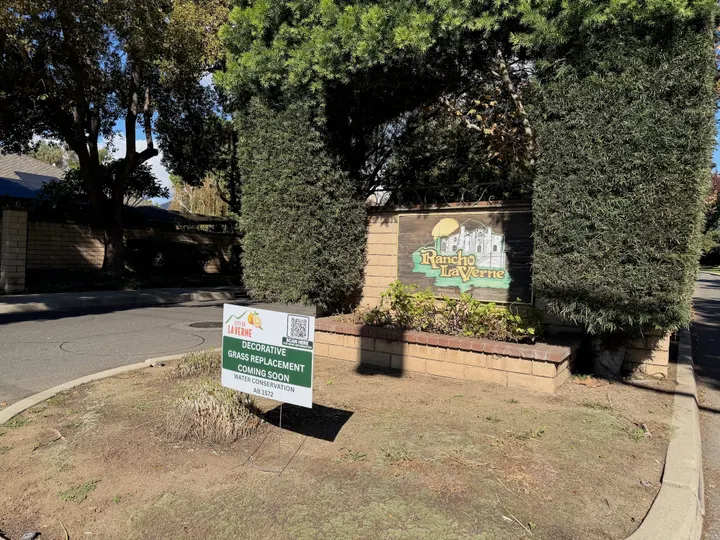
Following Resident Concerns, La Verne Pauses Turf Replacement Project
Work is on hold until at least the second week of December while the City gathers input on grassy areas residents say serve as play and gathering spaces.
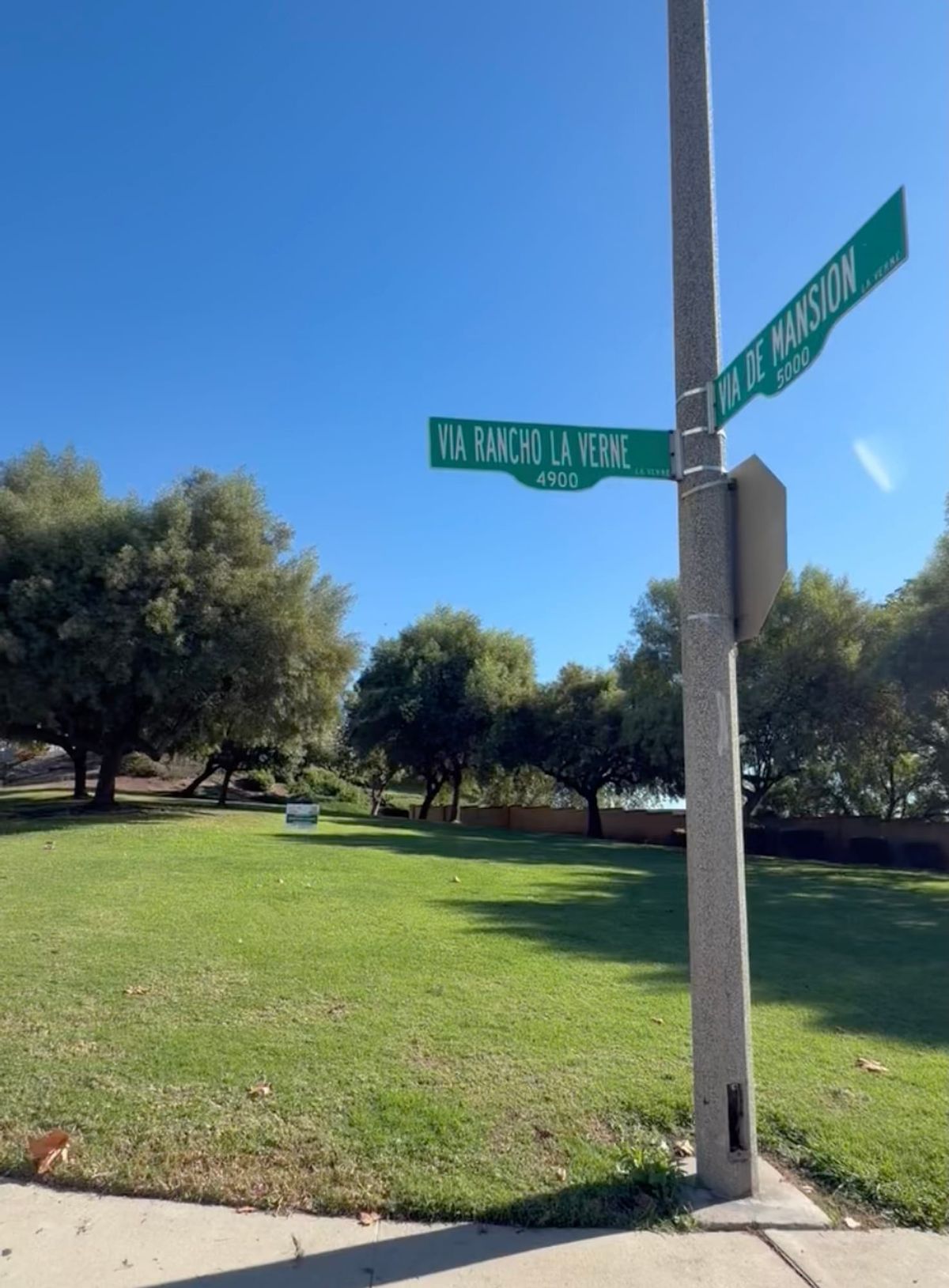
La Verne has paused its Rancho La Verne Turf Replacement Project until at least the second week of December to gather more resident input, following concerns that grass scheduled for removal serves as a place for children to play and neighbors to gather.
The City will review whether certain larger grassy areas qualify as “functional turf” under California’s water conservation requirements and consider possible revisions to the project. The pause does not establish which areas, if any, will be preserved.
In a social media announcement Wednesday evening, the City asked residents to document how they use the spaces for recreation, gatherings and other community activities. City staff confirmed that work would remain paused until at least the second week of December.
“Your feedback will help the City better understand how these areas serve the community and provide documentation to support any potential determination of functional turf use under State regulations,” the announcement said.
Residents seek to preserve larger greenbelts
Rancho La Verne resident Ashley Stewart said students and parents from La Verne Heights Elementary School use the large grassy areas closest to Baseline Road daily while waiting for older students to be dismissed.
“It’s a safe space for kids to run and play while they wait for the upper grades to be released,” Stewart said.
Stewart supports preserving the larger lawns closest to Baseline Road and Via de Mansion while allowing landscaping changes elsewhere along Rancho La Verne.
Resident Kristina Gandara Rodriguez said she first learned about the project while taking her children to school, then saw the extent of the planned removal while walking her dog.
“We want an area where our kids can be safe and play and enjoy the beautiful surroundings that we live in,” Rodriguez said.
She said neighborhood children run around together on the grass after school and hold lemonade stands during summer. The greenbelts also provide gathering space during holiday celebrations and busy events at Heritage Park.
“Whenever we have events going on at the park, people also spill out onto that grassy area,” she said.
In a letter to Mayor Tim Hepburn and City Manager Ken Domer, Rodriguez requested a pause in construction and grass removal while the City explained how it classified the turf, who approved the project and what assessment of community use informed the decision.
Rodriguez said she would prefer the project not proceed in the neighborhood but wants, at minimum, to preserve the larger grassy areas.
What the original project proposed
Before the pause, the City’s published plans called for removing approximately 63,869 square feet of turf and adding 2,546 plants across four Rancho La Verne landscape maintenance district areas. Proposed improvements included drought-tolerant plants, drip irrigation, mulch, and a decorative river rock feature.
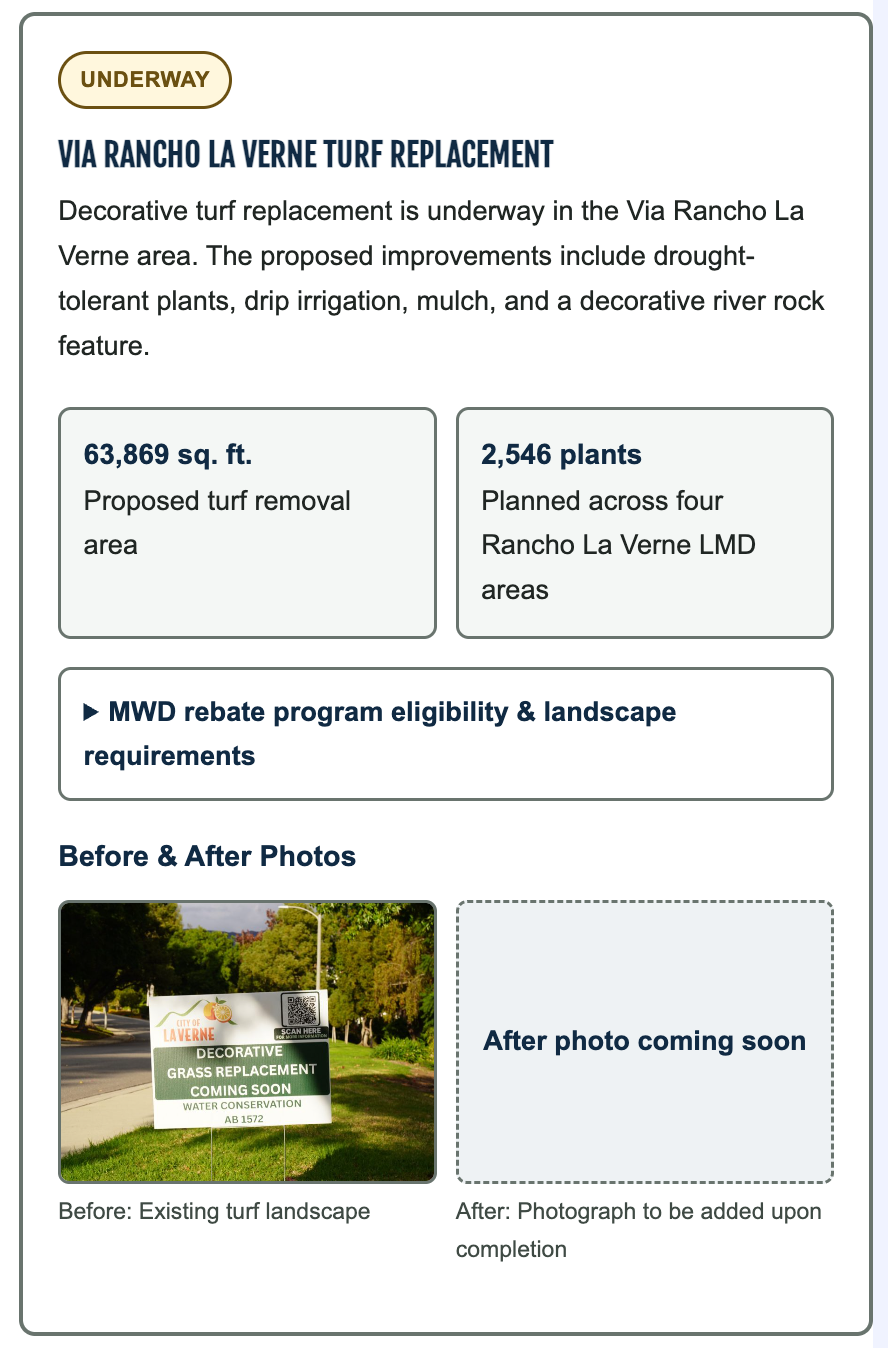
Public Works Director Danny Wu said in an email to La Verne Daily News that the proposed project would cost $191,608.80. The City received approval for a Metropolitan Water District of Southern California rebate of $3 per square foot, totaling $191,610, which Wu said was expected to fully cover the proposed cost.
Wu projected a 40% to 50% reduction in water consumption based on the completed Wheeler/Tabor Turf Replacement Project. He also expected maintenance needs to decrease, although he did not provide an estimated dollar savings for water or maintenance.
Before the pause, Wu estimated construction would take 30 to 45 days, depending on weather and scheduling around the holidays. He said the City did not anticipate major disruptions to street or sidewalk access and would arrange safe alternative access if temporary sidewalk closures were necessary.
The City has not announced revised project boundaries, costs, water-saving estimates or a construction schedule.
Why the turf classification matters
California’s Assembly Bill 1572 prohibits using potable water—water suitable for drinking—to irrigate qualifying nonfunctional turf at specified properties. Most covered local government properties must comply beginning Jan. 1, 2027. Other commercial, industrial and institutional properties generally face a 2028 deadline, followed by qualifying homeowners association common areas in 2029.
The law restricts watering; it does not require grass removal.
State guidance distinguishes grass in recreational use areas and community spaces from ornamental turf.
- Mowed grass located within street rights-of-way and parking lots.
- Mowed grass enclosed by fencing or other barriers to permanently keep people out.
- Mowed grass bordering signs, buildings, or sidewalks
Functional turf, in contrast, includes mowed grass used for recreational activities such as community gatherings, formal sports games, or informal recreation in a park or other green area.
source: State Water Resources Control Board
Wu described functional turf as maintained grass regularly used for recreation, sports, civic activities, or community gatherings; and nonfunctional turf as primarily ornamental, citing medians, parkways, building perimeters, and other decorative landscaping.
He did not describe site-specific observations or assessments of the lawns residents identified as play and gathering spaces. The City’s subsequent announcement said resident feedback would help inform its review of those areas.
The State Water Resources Control Board directs questions about individual turf classifications to local public water systems and says it does not currently plan to decide individual cases.
Rebate funding has a separate deadline
MWD’s public agency turf replacement program generally gives participating agencies 180 days after their funding reservation is confirmed to complete a project and submit a rebate request. Additional time may be granted on a case-by-case basis. That schedule is separate from the state law’s watering restrictions.
The City’s specific rebate completion deadline and how a pause or changes to the project could affect the approved funding have not been confirmed for this story.
Landscape costs provide broader context
The project comes amid financial pressure on La Verne’s landscape maintenance districts, which use property assessments to maintain shared landscaping.
As La Verne Daily News reported in March, rising water, labor and equipment costs were straining district budgets. Most districts were spending more than they collected in assessments, with reserves covering the difference. At that time, the City was pursuing Metropolitan funding to help pay for turf conversions.
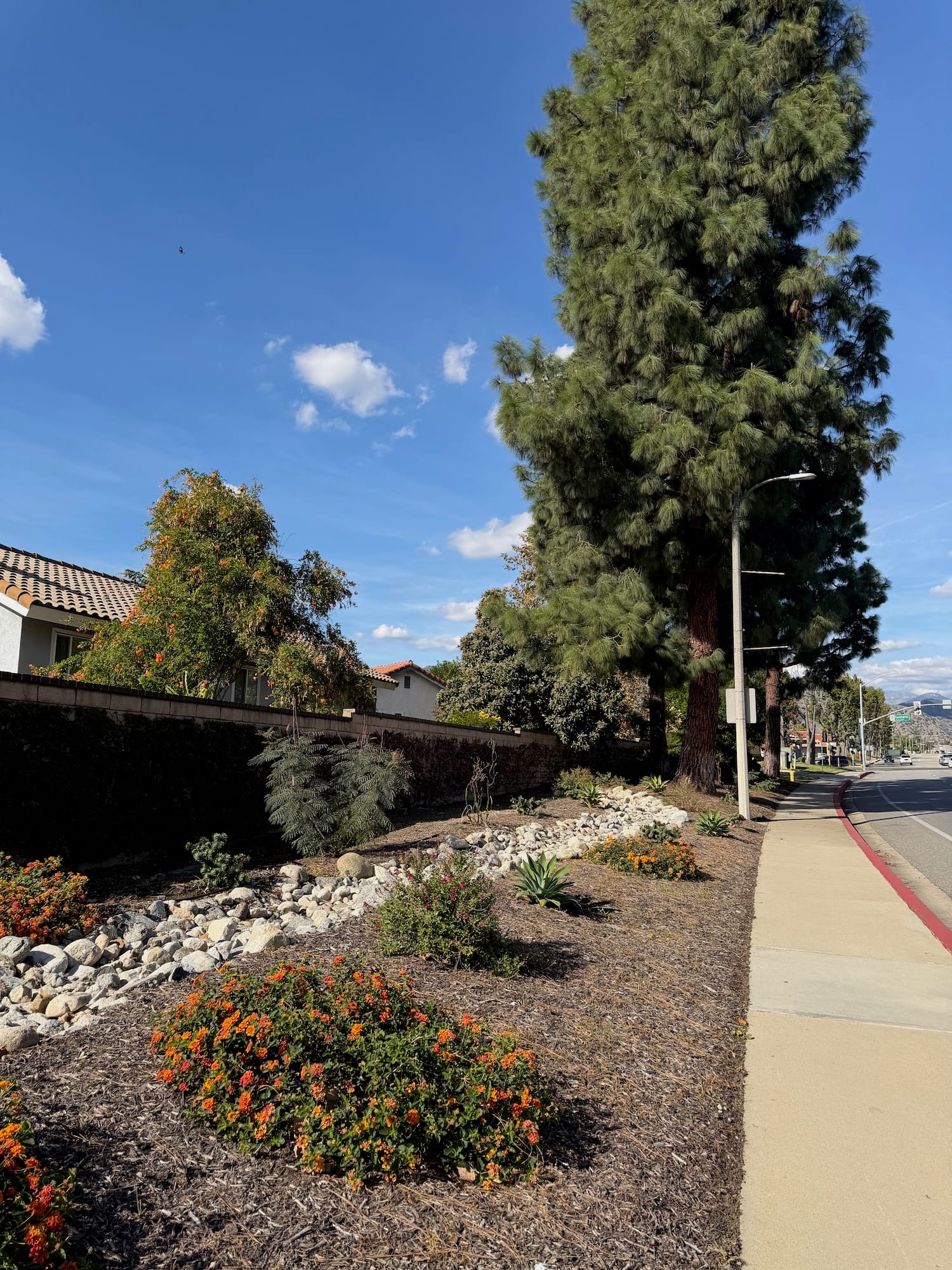
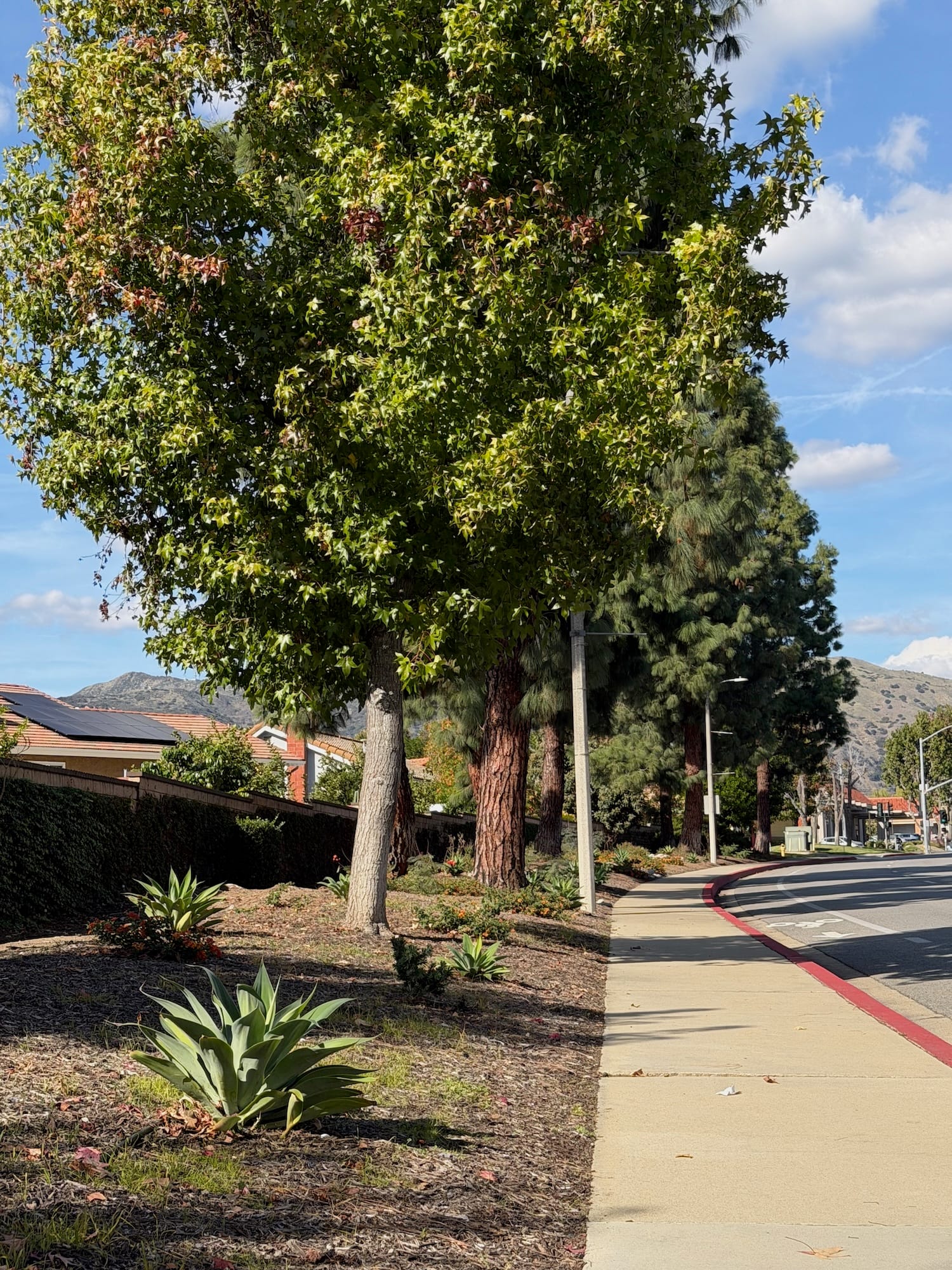
The west side of Wheeler Avenue between Foothill Boulevard and Tabor Lane, where turf was removed and replaced with drought-tolerant plants, mulch and decorative river rock. Photos by Staci Baird/La Verne Daily News
How to share your experience
Residents who regularly use the grassy areas along Via Rancho La Verne can email CityClerk@LaVerneCA.gov describing the locations, activities and frequency of use. The City said that information will help document existing recreational and community uses as it considers potential project revisions.