What Is Measure GG? A Look at the Funding Source Behind La Verne's Paramedic Services
As City leaders consider potential updates, here's what residents should know about the voter-approved funding measure that supports local emergency medical care.
Correction: 4:52 p.m. June 25 information regarding EMS billing was updated to more accurately explain the increase.
Correction: 2:55 p.m. June 26 updated to clarify that the City never bill residents for EMS services. Confirmed by Fire Chief Brandon Coatney.
What Is Measure GG?
La Verne voters approved Measure GG in 1980 to help pay for emergency medical services, creating a dedicated funding source that has supported the City's paramedic and ambulance operations for more than 40 years. Measure GG funds are restricted by law and may only be used for paramedic and ambulance services.
But Measure GG is not just paying for ambulances. It's paying for a modern advanced life support system that includes firefighter-paramedics, dedicated ambulance operators, specialized equipment, ongoing training, and the ability to keep paramedics available in La Verne for high-acuity emergencies.
Now, City officials are considering whether to increase the Measure GG assessment as rising personnel, equipment and operating costs outpace revenue generated by the measure.

What Does Measure GG Pay For?
Measure GG helps fund La Verne's Advanced Life Support emergency medical services, ambulance transport operations and resident ambulance billing program.
Under that program, the Fire Department may bill insurance providers for ambulance transport and emergency medical services, but residents do not pay out-of-pocket costs beyond the Measure GG assessment for covered services.
Today, La Verne's emergency medical system includes firefighter-paramedics and ambulance operators who respond to thousands of calls each year. In fact, according to City Manager Ken Domer, approximately 74% of Fire Department responses during the past year were medical emergencies.
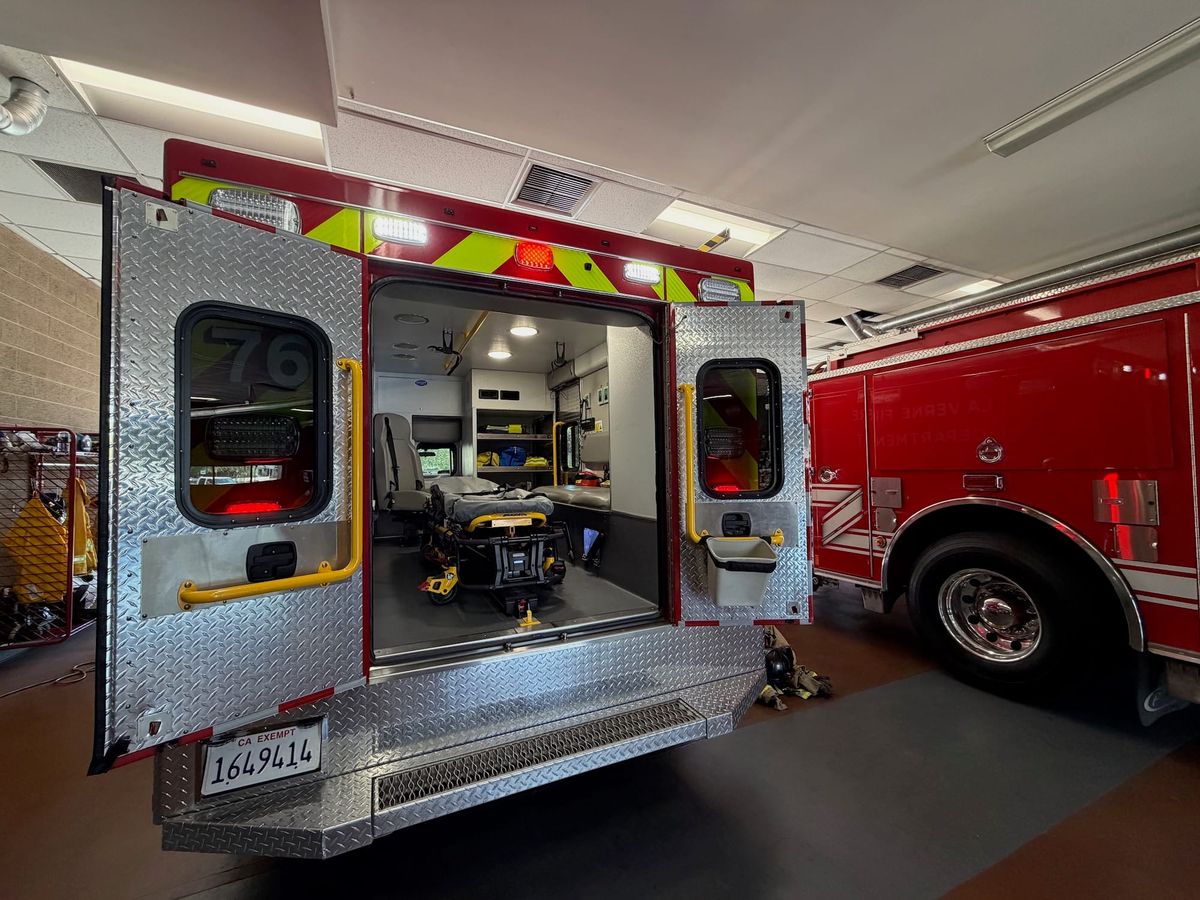
And, unlike some communities that rely entirely on private ambulance companies, La Verne operates its own ambulance service. La Verne Fire Chief Brandon Coatney said the City's two dedicated ambulances are staffed by ambulance operators, allowing firefighter-paramedics to remain in the City and reducing average response times for critical calls.
Who Pays for Measure GG?
Measure GG is assessed on approximately 12,800 billable units citywide.
Finance Director Christy Lopez said the figure includes more than single-family homes. Certain institutional and multi-unit properties are assessed based on the number of units or rooms.
The Measure GG assessment began at $1.75 per month in 1981. The current assessment is $6.70 per month and appears as "PARAMEDIC SERVICE" on City utility bills. Lopez said the assessment will increase to $6.90 per month beginning in July through the measure's Consumer Price Index adjustment.
How Much Revenue Does Measure GG Generate?
Measure GG generated approximately:
- $960,044 in FY 2022-23
- $1,008,604 in FY 2023-24
- $1,022,457 in FY 2024-25
- $1,042,992 in estimated FY 2025-26 revenue
What Other Revenue Supports Paramedic and Ambulance Services?
Measure GG is only one source of funding for the City's emergency medical services program.
The City also receives revenue through EMS insurance billing, including reimbursements from private insurance, Medicare, and Medi-Cal, as well as federal matching funds through California's Public Provider Ground Emergency Medical Transport program, known as PP-GEMT. The program requires the City to document eligible costs, comply with state and federal requirements, and make an upfront contribution to receive matching funds.
According to Senior Management Analyst Jennifer Brown, the City recovers more through PP-GEMT reimbursements than it contributes, even after paying about $225,000 annually in state administrative fees. Those funds are deposited into the General Fund.
EMS billing revenue has grown from about $1.19 million in fiscal year 2022-23 to an estimated $1.88 million in fiscal year 2025-26, according to Lopez.
| Fiscal Year | EMS Billing Revenue |
|---|---|
| FY 2022-23 | $1,187,735 |
| FY 2023-24 | $1,737,461 |
| FY 2024-25 | $1,832,923 |
| FY 2025-26 (Estimated) | $1,880,000 |
City officials attribute the increase to higher call volume, increases in the County's general public ambulance rates (which are what the City uses to establish billing rates), and the City's change in service model. Lopez said that the change reduced the City's reliance on firefighter-paramedics to staff ambulances and allowed the City to return to primarily providing ambulance transport with City personnel.
The Fire Department began billing insurance in 2003 through a third-party provider. According to Coatney, the department now collects about 82% of billable insurance revenue. Lopez said annual collections can fluctuate based on transport volume, payer mix, reimbursement rates, and PP-GEMT activity.
How Much Does the Service Cost?
City staff estimates the annual cost of providing paramedic and ambulance services at approximately $3.88 million. Measure GG and EMS billing is estimated to bring in about $2.76 million in revenue, leaving an unfunded cost of about $1 million. The City uses the General Fund to cover the shortfall.
Lopez cautioned that these figures are planning-level estimates.
"Staff intends to conduct a more detailed review of the methodology used to calculate the cost of paramedic and ambulance services," Lopez wrote in an email.
The current methodology includes:
- Paramedic staffing costs.
- Compensation associated with paramedic assignments.
- The full cost of the ambulance operator program.
- Related operating expenses (including supplies, equipment, ambulance replacement and ambulance maintenance)
Chief Coatney said rising personnel costs are only part of the equation. Medical equipment required to operate an advanced life support system has become significantly more expensive over time.
Local and state emergency medical services requirements also mandate equipment and technology that were not available decades ago. One example is the cardiac monitors that paramedics use to assess heart rhythms, perform diagnostics and deliver lifesaving treatment. These devices currently cost about $32,000 each.
Another example is automated CPR devices, which provide consistent chest compressions during cardiac arrest emergencies. Coatney said the equipment improves care but adds to the cost of operating an emergency medical system.
How Does the City Measure Success?
City officials point to improved emergency medical outcomes as one benefit of maintaining an in-house paramedic and ambulance system.
Before the City's 2022 deployment changes, firefighter-paramedics assigned to ambulances could spend hours waiting at hospitals before transferring patients. Coatney said the current system keeps paramedics in the community and available for emergency calls rather than tied up at hospitals.
Coatney has also reported improved cardiac arrest survival rates since operational changes implemented in 2022. According to Cardiac Arrest Registry to Enhance Survival (CARES) data, La Verne's cardiac arrest survival rates exceed county, state and national benchmarks. Coatney said the department's success in restoring a pulse in cardiac arrest patients more than doubled, rising from 14.8% to 33% in 2025 among patients initially found without a pulse by first responders.
What are the Options for Closing the Funding Gap?
City officials have identified several possibilities for closing the funding gap.
Increase the Measure GG Assessment.
Staff presented examples showing how increasing the monthly assessments would generate additional revenue. No specific amount has been proposed.
- $12.50 per month could generate about $1.92 million annually.
- $14 per month could generate about $2.15 million annually.
- $15 per month could generate about $2.3 million annually.
Continue Using General Fund Dollars.
The City could continue subsidizing the program, though those dollars also support police services, parks and recreation, street maintenance and other operations.
Explore Alternative Funding Models.
Officials have discussed options used in other communities, including subscription-based programs and other revenue sources.
Ballot Measure or Prop 218 Process?
During the June 15 City Council meeting, City Attorney Kim Barlow said the City could pursue either a traditional ballot measure or a Proposition 218 process.
According to Barlow, a ballot measure would cost approximately $70,000, compared with about $25,000 for a Proposition 218 proceeding.
The Proposition 218 process generally includes these steps:
- The City prepares an assessment proposal and supporting analysis.
- Property owners receive mailed notices explaining the proposed assessment.
- Public hearings are held to gather community input.
- Property owners vote on the assessment.
- If approved, the new assessment can be implemented.
The Prop 218 process would require a 50% plus one positive vote (not a protest vote) and would go to every billed parcel, not just registered voters.
What Are Residents Saying?
Residents have expressed a variety of viewpoints.
Jim Gilmartin said his family has relied on La Verne firefighters and paramedics for decades.
"They are a bargain at the current assessment level, and I support any increase commensurate with completion of the definitive study," Gilmartin said.
During the June 15 City Council meeting, several residents spoke during public comment on the item. Kathy Kalousek supported an increase.
"We pay a very small fee," Kalousek said. "I've looked at this for years and thought, we should bump this up a little."
Stephen Wiard called the current assessment "a heck of a bargain" at $6.90 per month.
Other residents have urged caution.
Rick Bowen said residents are facing increasing costs and fees.
"In this case, it's a death of a thousand taxes," Bowen said. "Every time we turn around, there's a new fee."
Resident Bill McKenna encouraged the City to examine alternatives used by neighboring communities, including subscription-style programs.
Questions also emerged about how any increase should be approved.
"I don't have a problem with raising it," Pam Berry said. "But I do have a problem with the processes not being really equitable."
Council Member Rick Crosby said many residents may not realize they already pay for paramedic services through Measure GG and questioned how the City can better educate the community about the assessment and its purpose. (Cue your local news source!)
What's Next?
The City Council is expected to continue discussing Measure GG throughout the summer.
Officials will return with additional information on potential funding options at the July 20 City Council meeting, including a possible Prop 218 process and other alternatives.
As the City moves forward with a proposal, residents will have opportunities to provide input before any increase could take effect.
Provide your feedback and submit questions through the City of La Verne website
Upcoming City Council meetings
City Hall Council Chambers, 3660 D St., La Verne
6:30 p.m. Monday, July 20
6:30 p.m. Monday, Aug. 3
Comment in person at City Hall—fill out a speaker card before the next City Council Meeting.
Comment by email to cityclerk@LaVerneCA.gov—comments are shared with the full Council and become part of the public record.
Comment via Zoom—visit LaVerneCA.gov/zoom or call 1-669-900-6833, ID available in the meeting agenda packet. Raise your hand to request to comment.
Local Events Calendar