Campus Memorial Tours Share Stories of Service, Loss and Conscience
La Verne Historical Society walks explored six monuments honoring 11 service members and a plaque recognizing conscientious objectors.
An accomplished musician who became a military pilot. A young man who died of pneumonia during training. Two University of La Verne graduates killed in the Middle East.
Their histories were among those shared during walking tours of campus memorials sponsored by the La Verne Historical Society Nov. 6 and 7.
The tours explored six monuments honoring 11 service members, along with a plaque recognizing conscientious objectors who performed civilian public service. Together, the stops connected local residents and former students with the history of military service and the Church of the Brethren’s pacifist tradition in La Verne.
For Historical Society President Sherry Best, the recognition of different forms of service stood out.
“There is room for everyone,” she said.
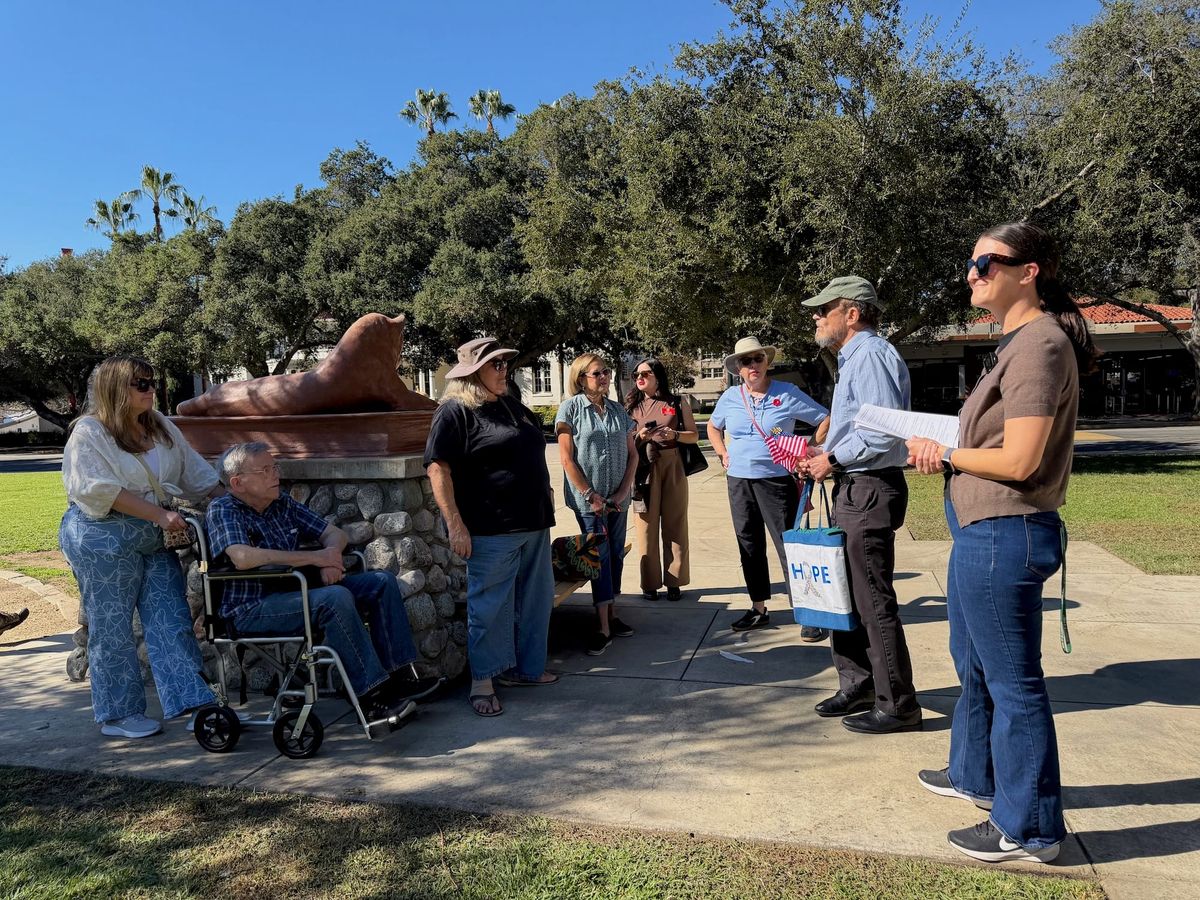
Professor emeritus Al Clark led Friday’s tour, and university archivist Keren Darancette shared the histories of the individuals behind each monument. Attendees were invited to place flags at each stop in remembrance.
Remembering those who served in World War I
The first two campus memorials began as oak trees planted on Armistice Day, Nov. 11, 1929, Darancette said. Boulder-mounted plaques were added a few years later.
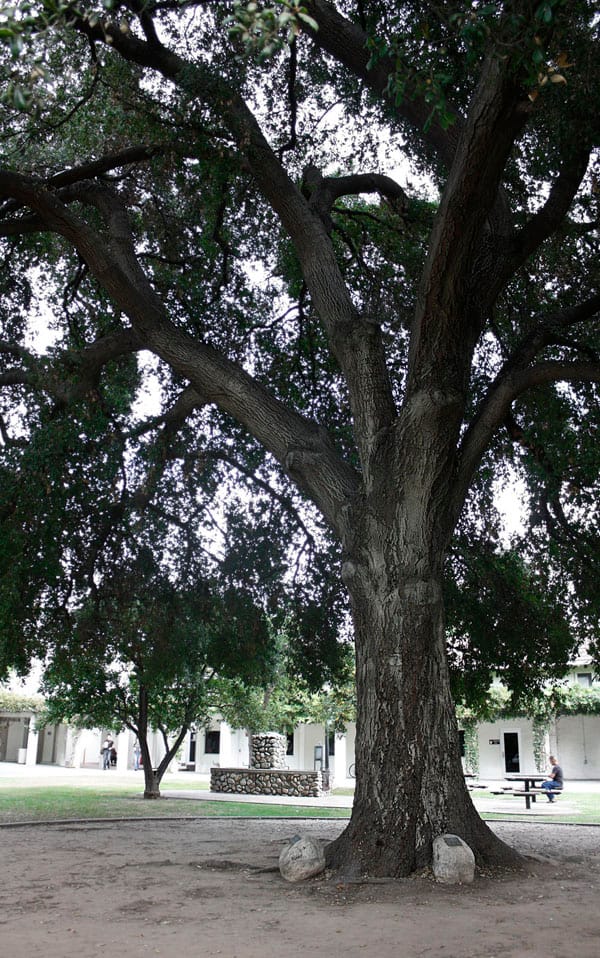
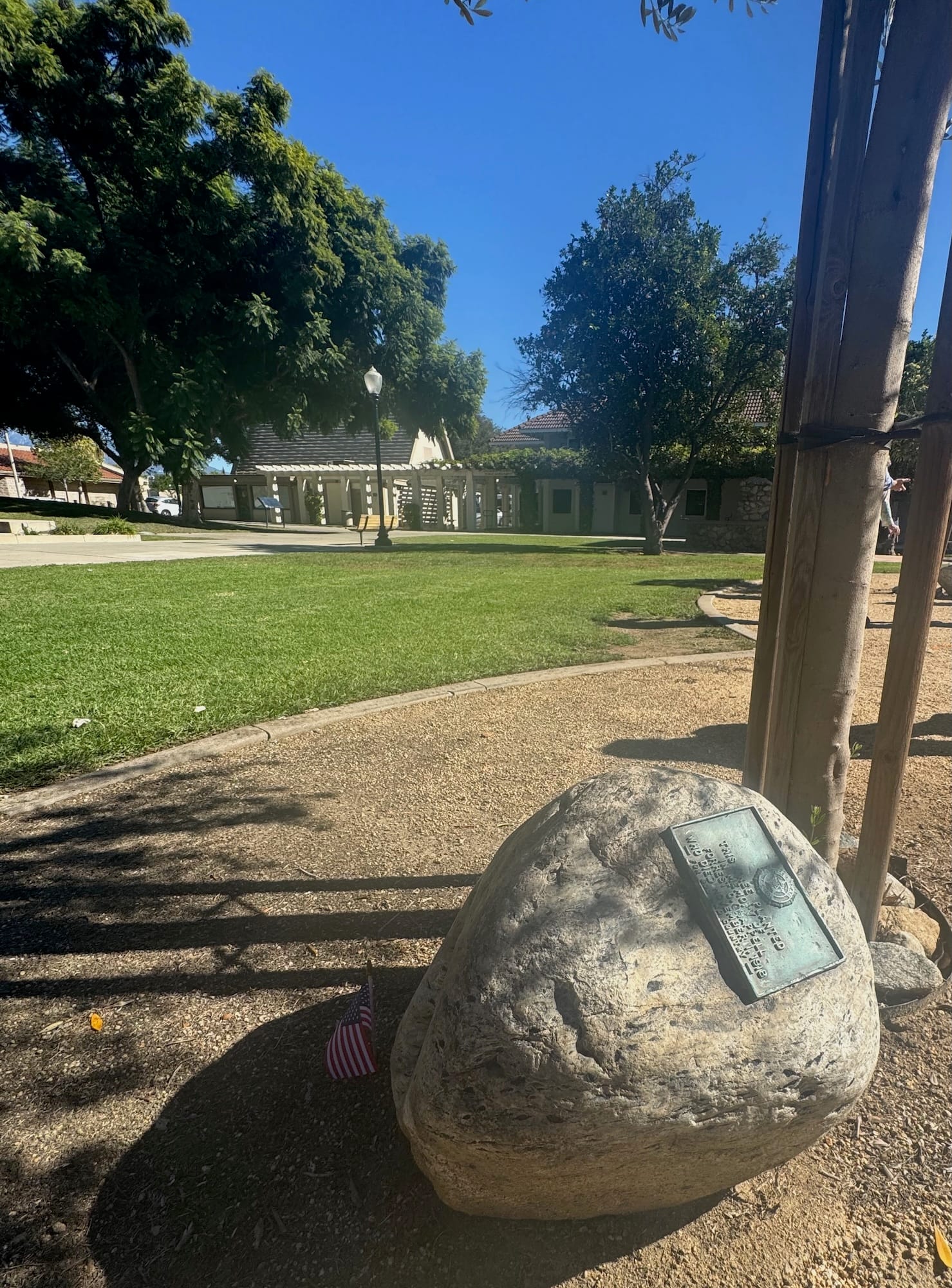
(First photo) An oak tree in Sneaky Park, west of the Wilson Library, was planted in memory of Donald F. Gaston and Forrest O. Chappell, soldiers who died in World War I. Photo circa 2009 by Stephanie Arellanes/Campus Times (Second photo). Chappell's memorial now sits under a newly planted tree in Sneaky Park. A series of storms toppled the three historic oak trees in 2023. Photo by Staci Baird/La Verne Daily News
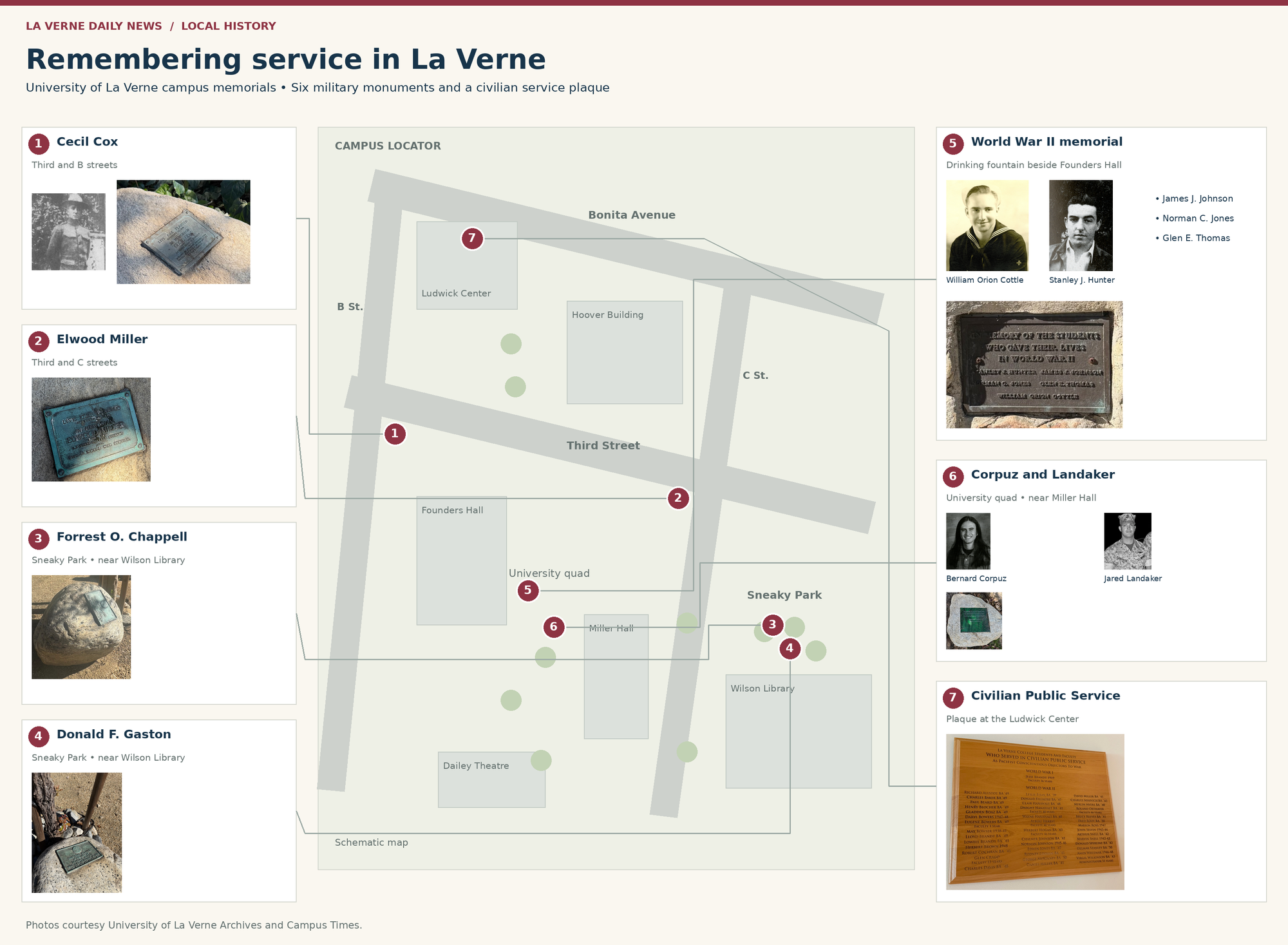
At Third and B streets, a memorial honors Cecil Cox, a May 1915 graduate of Lordsburg Academy. Cox served in the Army’s engineering corps and was killed by a nearby shell explosion in France in 1918.
His father, J.M. Cox, a former Lordsburg College teacher, donated $1,000 in 1933 to establish the John Cecil Cox Memorial Fund.
At Third and C streets, another memorial honors Elwood Miller, who died of pneumonia Nov. 4, 1918, at Balboa Park Hospital while training at Camp Kearny. His father, M.H. Miller of Reedley, was a La Verne College trustee.
Two other World War I memorials recognize La Verne residents Donald F. Gaston and Forrest O. Chappell. Their monuments stand in Sneaky Park, an area that was once a city park.
Gaston, a Bonita High School graduate who attended Penn State, died of pneumonia and scarlet fever at Camp Hancock, Georgia, on Nov. 26, 1918. He was the son of Dr. and Mrs. W.F. Gaston of La Verne.
Chappell died of influenza at Fort Rosecrans on Nov. 1, 1918. Already ill before arriving, he was hospitalized upon reaching the post, Darancette explained. His funeral was La Verne’s first military service funeral.
Trees honoring Gaston and Chappell were planted Nov. 11, 1929. Memorial markers followed on Nov. 11, 1930, and a rededication ceremony took place two years later.
After three large oak trees in Sneaky Park fell in 2023, the monuments were moved near newly planted trees in the same area.
Five names on a World War II memorial
A drinking fountain beside Founders Hall honors five former La Verne College students who died in military service during World War II. It was dedicated on Memorial Day in 1949.
The names are Stanley J. Hunter, James J. Johnson, Norman C. Jones, Glen E. Thomas, and William Orion Cottle.
Darancette was able to share details about three of the men.
Hunter, a member of the class of 1940, was an accomplished musician and music major who earned his pilot’s license before enlisting. He volunteered for the Army Air Corps, trained in California and received his wings at Luke Field in Arizona. He was killed in action in the Pacific on April 3, 1943.
Thomas, a member of the class of 1938, excelled at basketball and became a teacher before entering military service. A flight commander, he died June 19, 1943, when his bomber exploded shortly after takeoff in North Africa, killing him and his crew, Darancette said.
Cottle served in the Navy and was killed June 16, 1943, when the USS LST-469 was torpedoed off Australia’s eastern coast.
A call to remember two more graduates
Another memorial in the university quad honors Bernard Corpuz and Jared Landaker, both members of the university’s class of 2003.
Corpuz studied political science and competed on the track team. An Army corporal, he was killed in an improvised explosive device attack in Afghanistan on June 11, 2006, according to a Campus Times editorial.
Landaker, a Marine first lieutenant who served on medical evacuation missions, died Feb. 7, 2007, when his helicopter crashed near Fallujah, Iraq, the editorial reported.
Published less than a month after Landaker’s death, the editorial urged the university to create a memorial honoring the two graduates alongside those remembered from earlier wars. It also called for campus Veterans Day observances.
In 2021, then-University of La Verne President Devorah Lieberman proclaimed Veterans Day a university holiday.
Today, Corpuz and Landaker are remembered together with a tree and memorial marker on campus.
Service and conscience
The tour also examined how military service and conscientious objection fit into the university’s Brethren heritage.
Members of the Church of the Brethren founded the institution in 1891 as Lordsburg College. It later became La Verne College and, in 1977, the University of La Verne. The Brethren also established Hillcrest retirement community.
Clark explained that the college was closely tied to the church and its pacifist ideals during World War I. By World War II, students represented a wider range of Christian denominations, many of which did not share that tradition. Students’ choices about military service varied, including among those from historic peace churches.
At Friday’s final stop at the Ludwick Center, Charles Cable spoke about his experience serving with International Voluntary Services as a conscientious objector. A plaque honoring conscientious objectors who served through Civilian Public Service hangs on a wall on the first floor of the building.
The free public tours were part of La Verne’s city-approved America 250 celebration. Ken Pucci of LVTV/KWST filmed the tour, and a recording will be posted to the La Verne Television YouTube channel.
The news is free. Reporting it isn't. Help me give La Verne another year of local news you won't find anywhere else!