Public hearing set as La Verne weighs substantial increases to water and sewer rates
City officials say the adjusted rate plan would fund rising water costs and infrastructure upgrades. A public hearing is set for Nov. 3.

💧 At a glance
- Multi-year plan would raise residents’ water and sewer bills beginning in 2026 with a maximum possible increase of 75 percent, according to city officials.
- A Proposition 218 public hearing is scheduled for Nov. 3 at La Verne City Hall. Residents can submit written protests or objections before the hearing to share their feedback on the proposed rates.
- City leaders say the adjustments are needed to cover rising costs for imported water, infrastructure repairs, and operations. The city hasn’t raised rates since 2019, and its water fund is projected to run short in 2026 without changes.
Corrections: The Nov. 3 City Council meeting begins at 5:30 p.m. with a closed session. The regular meeting begins at 6:30 p.m. This story was updated at 8:28 a.m. Nov. 1.
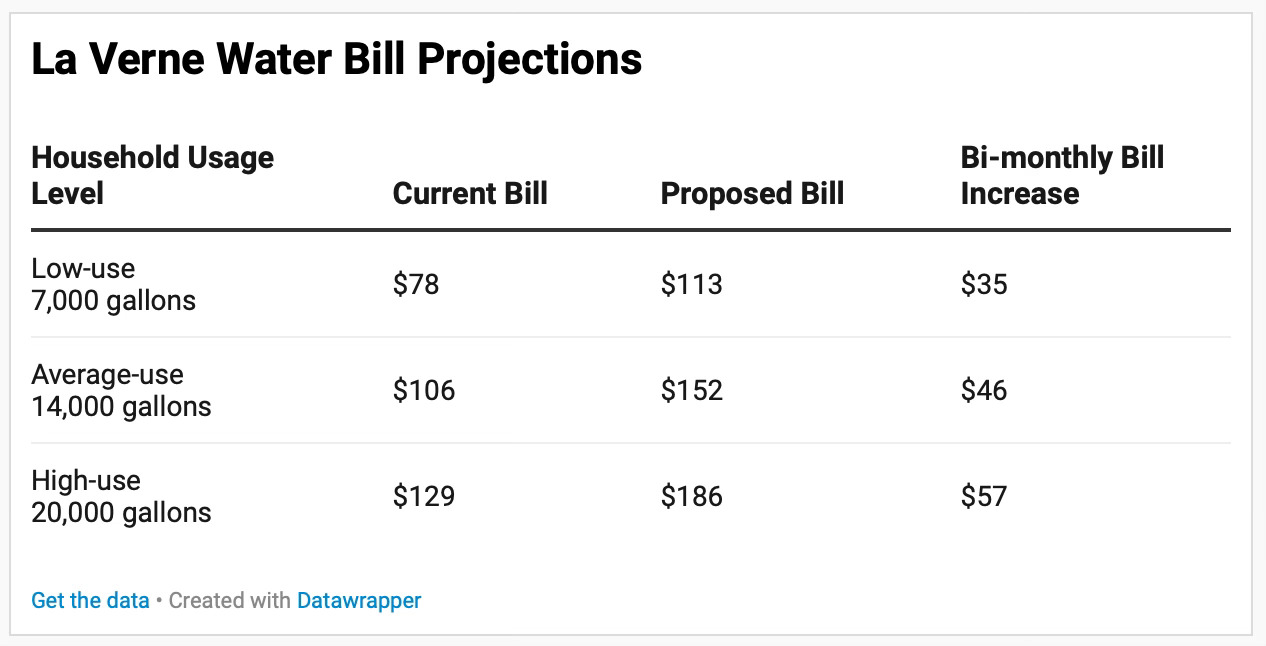
The embedded table “La Verne Water Bill Projects” incorrectly labeled the last column. That columns is the bi-monthly bill increase. The increase for low-use 7,000 gallons is $35 per bi-monthly bill. This information was updated at 4:48 p.m. Oct. 25.
The cost of keeping water flowing
La Verne residents could see higher water and sewer bills next year under a new rate plan the City is considering to cover increasing costs for water, maintenance, and daily operations. The proposed multi-year rate plan would raise rates 50 percent in January 2026 with an additional 25 percent increase at the start of FY 2027 on July 1, 2026.
Low-use households (7,000 gallons) could see bills rise from $78 to $113. Average-use households (14,000 gallons) from $106 to $152. Higher-use households (20,000 gallons) from $129 to $186. In this tiered structure, those who use more water pay more.
Most households would see rates go up between 25-40 percent, with a 75 percent maximum increase, according to Kristie Sanchez, senior management analyst with the City’s Public Works Department.
Residents can calculate their projected bills using the City’s online Bill Calculator and review the full water and sewer rate study, frequently asked questions, and how to participate in the upcoming hearing on the City’s website.
Without a rate increase, the City’s water fund will only be viable through June 30, 2026. “We could potentially squeeze through this fiscal year,” said City Manager Ken Domer. “We have to do something.”
Some residents, meanwhile, are concerned about the financial impact, especially on fixed-income households.
“It’s going to be hard on a lot of citizens,” said La Verne resident Christine Slussa. She’s also concerned the increases will drive up her homeowners association dues because her neighborhood includes a lot of green space.
“The water rates going up this high is going to affect my association, and I feel my association is already high,” she said.
The adjusted rate plan, which would take effect in January 2026 if approved, will be discussed at a public hearing during the Nov. 3 City Council meeting. The council may approve the plan as proposed, lower the increases, or delay implementation.
According to Domer, the City is reviewing whether effective dates could be adjusted and expects to provide an update at the hearing.
The City’s first comprehensive water and sewer rate study, conducted by the independent consultant Raftelis this year, found that current rates no longer cover operating and capital costs. La Verne has not increased its water or sewer rates since 2019.
Rising costs—particularly for imported water, which makes up about 75 percent of La Verne’s supply from the Colorado River and Northern California—have contributed to the shortfall. The City’s plan includes about $32.2 million capital investment through 2030 for pipeline repairs, sewer relining, and other system upgrades. Because water and sewer services are funded through enterprise accounts, they must cover their own expenses and cannot draw from the general fund.
Slussa, and several other residents have been posting on Facebook and distributing flyers and form letters at local grocery stores urging the community to submit letters of protest.
“My goal is to stop the 75 percent rate increase in six months and stop the sewer rate increase entirely,” Slussa wrote in an email.
According to the City of La Verne’s website, an Ad Hoc Water and Sewer Rate Study Committee, a temporary volunteer group formed to advise the City Council during the rate study process, consisted of a five-member committee made up of current water and sewer customers. The committee reviewed rate structure options and offered feedback on priorities such as social equity, administrative feasibility, and public outreach. La Verne resident Richard Bowen was a member of the City’s Ad Hoc Water Rate Study committee.
“They’re playing catch up,” Bowen said. “They say, ‘Well, we haven’t done this for the last five years.’ Well, that doesn’t mean anybody can afford a huge increase in January.”
The Ad Hoc committee voted 3-2 at their July 30 meeting to recommend “Scenario 5” to the City Council (page 15 in the July 10 slides presentation). The scenario includes a $4 million loan from the sewer fund with reserve fund balances meeting targets FY 2026-FY 2030, loans repaid over three years from FY 2028-2030, and a positive cash flow 2027-2030. It also includes an increase in water rates (page 17 in the July 10 slides presentation for a detailed proposed rate table).
Residents are encouraged to practice water conservation to lower their water bills. Conservation rebates through programs like SoCal WaterSmart offer discounts for water-efficient appliances and landscaping.
“Conserving water remains the most effective way to manage and reduce bi-monthly utility costs. Even modest reductions in water use can lead to meaningful savings on a customer’s bill,” Sanchez wrote in an email.
To comply with Proposition 218, the City must ensure water rates reflect the actual cost of providing service and cannot charge one customer more to subsidize another. Domer said a 2023 court ruling involving Los Angeles’ low-income water subsidy program reaffirmed that limitation.
In 2024, the City reported disconnecting 197 residential water services for non-payment. The City doesn’t currently offer any bill assistance programs. “We’ve talked about it, and we’re going to be looking at all of that, but we don’t have anything in place right now,” Domer said. “We have to look at other funding options to provide any low-income or senior subsidies.”
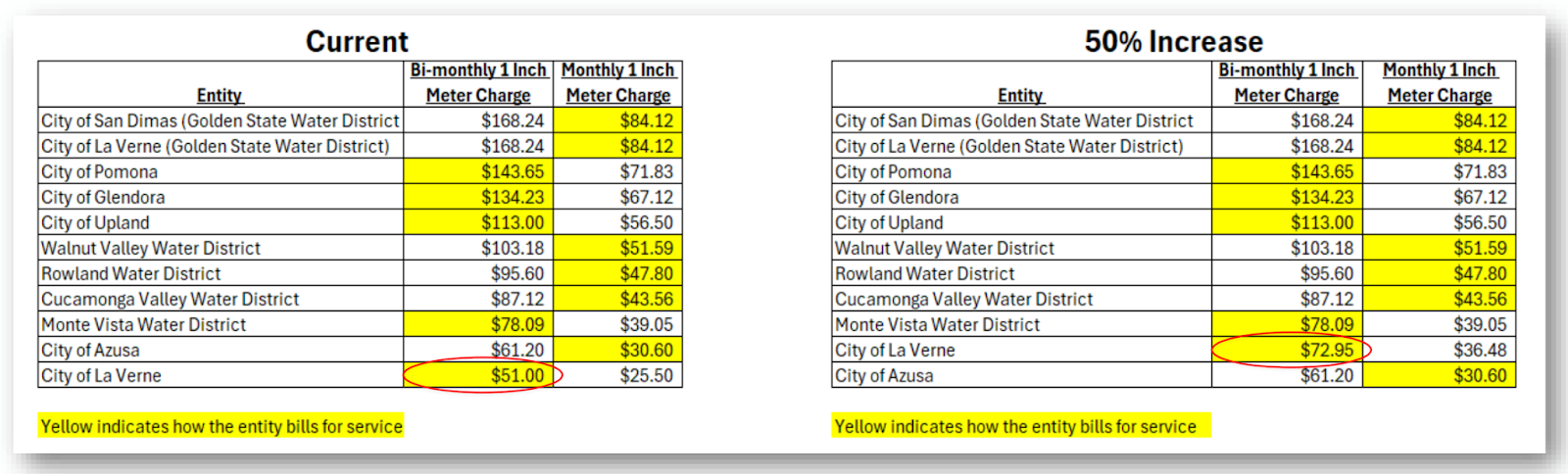
City materials note that La Verne’s water costs remain among the lowest in the region, even with the adjustments.
Domer said the City is committed to transparency and following recognized water industry best practices. “From here on out, we’ll be doing water rate studies every five years,” he said.
A notice of public hearing was mailed to households or property owners with an account in September.
Residents can share feedback in person in support of or opposition at the public hearing on Nov. 3.
Public Hearing
Proposition 218 public hearing regarding proposed water and sewer rate adjustments.
5:30 p.m. Monday, Nov. 3
La Verne City Hall, Council Chambers
3660 D St., La Verne
Under Proposition 218, at least 4,770 written protests are required for the City Council to be prevented from approving the rate increases. Any property owner who receives water from the City and receives a water or sewer bill in their name can submit a letter. Protest letters must be signed and submitted by the property owner before the end of the public hearing Nov. 3 to be considered valid under Proposition 218. Renters who receive water bills in their name are also eligible to sign protest letters. Written objections are different from written protests. A written objection lets you keep the legal right to challenge the rates later. A written objection must specify reasons you believe the rates do not comply with Proposition 218
Objections
Written Objection due by 4 p.m. Oct 27
This is different from a protest. A written objection lets you keep the legal right to challenge the rates later. Explain the specific reasons you believe the rates do not comply with Proposition 218, plus your name, service address or parcel info, and your original handwritten signature.
Email, mail, or deliver your written objection in person.
Email: cityclerk@laverneca.gov
Mail: City Clerk – Utility Rates Protest, 3660 D St., La Verne, CA 91750
In person: La Verne City Hall, 3660 D St., La Verne
If you do not submit a timely written objection, state law may bar a later legal challenge. There is a 120-day statute of limitations after Council adoption.
Protests
Written Protest due by 4 p.m., Nov. 3
No email or fax accepted.
Mail: City Clerk – Utility Rates Protest, 3660 D St., La Verne, CA 91750
In person: La Verne City Hall, 3660 D St., La Verne
This is how you say “no” to the proposed rates. Written protests are counted. If more than half of parcels submit valid protests, the Council cannot adopt the rates.
Include all of this information in your written protest:
1) say you oppose water, sewer, or both;
2) your name (property owner or account holder);
3) service address or parcel info;
4) your original handwritten signature. (Electronic signatures cannot be counted.)
Questions or need help?
Call (909) 596-8744 or email ratestudy@laverneca.gov
This article leveraged Qwen, a large language model developed by Tongyi Lab, ChatGPT, and Apple Notes used for research and organization, with all facts verified through city documents and a human editor.
Veteran reporter and my former colleague Ralph Schwartz helped edit this story.
Corrections policy
Accuracy is at the core of my journalism, and when I make mistakes, I will correct them promptly and clearly.
If an error appears in one of our stories, I will correct it as soon as it is verified. Online stories will include a note explaining what was corrected and when the change was made. Significant updates or clarifications will also be labeled to ensure readers understand what has changed and why.
I ask our readers’ help in identifying errors or omissions. If you believe I’ve made a mistake, please email me staci@lavernedaily.org with the story headline, link, and details of the issue. I will review all concerns carefully and appreciate the opportunity to make our reporting more accurate and complete.
My goal is not only to correct mistakes but to learn from them—strengthening my commitment to fair, factual, and community-powered journalism that earns and keeps your trust.
Community-powered news starts with you.
I launched La Verne Daily News to fill a local news gap. My mission is to provide fair, fact-based reporting about the people and policies that shape our community. I believe access to reliable local information isn’t just a service — it’s essential to civic engagement and community safety. Your support will help me report and share local news focused on what matters.
Trustworthy local information is the foundation of a safe, connected, and engaged community. Join me in building a local news source our community can count on!
Thank you so much to all the folks who have already subscribed to La Verne Daily News on Substack and donated to support my work. We are just getting started!
We’re on Instagram @LaVerneDailyNews.
This work is licensed under CC BY-NC-ND 4.0.
Local Events Calendar