Measure A Explained
What to know about Bonita Unified School District's proposed bond before you vote. Use this searchable guide built from La Verne Daily News reporting, or scroll the FAQ.
Frequently Asked Questions
As new information is added to this FAQ, I will add notes with a date/time here:
5:10 p.m. May 25 Added more information about Measure A's project list.
12:24 p.m. May 23 Added a link to the Bond Oversight Committee's Annual Reports.
11:19 a.m. May 23 I was unable to find more recent reports on the previous bond measures C and AB in time for publication, but I will update that section of the FAQ if more information becomes available.
8:19 a.m. May 23 This FAQ was updated with revised figures for the Measure C, AB and A calculations. I also added a note regarding assumptions regarding the example home’s assessed value.
Special thanks to my partners at Branch Four Inc. for validating calculations.
What is Measure A?
Measure A asks voters to authorize up to $256 million in general obligation bonds (also known as GO bonds) to fund repairs and upgrades at Bonita Unified School District schools in La Verne and San Dimas.
Under Proposition 39—a statewide law approved by voters in 2000—the measure needs at least 55% approval to pass.
BUSD's Facilities Master Plan identified more than $200 million in repairs needed across all school sites, a figure that exceeds what the district's previous bond measures—Measure C, passed in 2004 and Measure AB, passed in 2008—were designed to cover. The district noted that state funding for school facility improvements is limited, leaving local districts to fund major repairs largely on their own.
Where would the money go?
Bond funds are legally restricted by state law to capital projects. They cannot be used for teacher or administrator salaries, pensions or any day-to-day operating expenses.
According to an email from Sonia Gomez Eckley, BUSD assistant superintendent, business services, the district is required to set aside 3% of the General Fund Expenditure Budget for deferred maintenance. This is between $4.5-$4.7 million each year. Gomez Eckley said each year, the entire amount is fully expended.
The district has identified specific facility needs driving the request, including heating and cooling systems more than 30 years old, plumbing with original components between 50 and 80 years old, fire alarm upgrades needed at most school sites and security cameras present in only about 15% of schools. Portable classrooms—which make up roughly one-third of all classrooms in the district, many more than 50 years old—are also part of the picture, along with science labs and career technical education facilities that no longer meet current standards.
Project List
School Repair, Safety and Upgrade Projects
(See pg. 9 in the Bond Resolution)
- Repair and upgrade fire safety
- Upgrade electric systems and wiring
- Repair and upgrade leaky roofs
- Repair gas and sewer lines
- Repair deteriorating classrooms
- Remove hazardous materials like asbestos and lead paint
- Replace 40-year-old air conditioning, heating, and ventilation systems
- Repair and upgrade plumbing
- Improve emergency communication systems
- Repair and upgrade school security
Additional information about the proposed repairs and renovations of each of the existing school and District support facilities and technology infrastructure upgrades can be found on pg. 10 of the Bond Resolution.
Projects That Improve Student Success
(see pg. 10 in the Bond Resolution)
- Help ensure all high schools have modern science classrooms
- Enhance classes and equipment that introduce students to skilled trades
- Update career training classrooms and labs
- Improve accessibility for students with disabilities
According to the Bond Resolution, cost estimates for these projects could change over time and may be affected by outside factors. Some projects may also be completed in partnership with other public agencies or nonprofit organizations. Final costs will depend on factors including finalized construction plans, contractor bids and actual construction expenses. Depending on those final costs, some projects could be delayed, scaled back or not completed.
District officials say approval could make BUSD eligible to apply for additional state matching funds for facilities projects.
➡️ More details on the projects are available in the full text of the Bond Resolution.
What would it cost me?
The projected tax rate is $59 per $100,000 of assessed property value annually, which the City of La Verne estimates would generate approximately $16 million per year within district boundaries while the bonds are outstanding (April 6 City Council Agenda Packet, page 109).
A few things worth understanding about that number:
Assessed value is not the same as your home's market value. It's set by the Los Angeles County Assessor's Office and is often lower than what a home would sell for, sometimes significantly so. The assessed value depends heavily on its last sale date, not current market value.
Look up your home’s current assessed value using the California Public Records search or the Los Angeles County Assessor’s Office Property Search.
According to an email from Sonia Gomez Eckley, BUSD assistant superintendent, business services, the median assessed value of a single-family home in the district for 2025-26 is about $502,845, so Measure A would add about $296.68 to the annual property tax bill. One limitation of this estimate is that it assumes the home’s assessed value would stay the same over 24 years, which is unlikely.
If Measure A follows the district’s typical general-obligation bond structure, taxpayers would likely pay it off over between 12 to 24 years. That means, if Measure A passes, those taxes will likely be paid through at least 2039, and possibly as long as 2051. The exact duration would depend on the final bond size, interest rate, and how the district structures the debt.
The total tax paid after 24 years on a house assessed at about $502,845 would likely be around $7,120.32.
What is the cumulative tax picture when you stack Measures C, AB, and A together?
One limitation of these estimates is that they assume the home’s assessed value would stay the same over 24 years, which is unlikely.
The district's current bond tax rate for Measure C and Measure AB is $67.89 per $100,000 of assessed property value annually.
For example: A home with an assessed value of $502,845
The homeowner is paying the following for BUSD bonds:
Measure C $341.38
Measure AB $341.38
Measure A $296.68
Total property tax for BUSD bonds: $979.44 per year or about $81.30 per month
Total paid after 24 years: $23,506.56
Can the amount I pay go up?
Yes, it will increase. The assessed value of a home rises up to 2% per year under Prop 13 and resets to market value when a property changes hands.
The Prop 39 ceiling is $60 per $100,000 for unified districts, so the most this bond could increase is $1.
Will I pay for the bond measure if I live in San Dimas but not in the Bonita Unified School District?
If you live in San Dimas but are not within the BUSD boundaries (e.g., if you are in the Charter Oak School District), you typically will not pay for a BUSD-specific bond measure. School bonds, authorized under Proposition 39, are property tax assessments levied only on homes within the district’s specific boundaries.
How would the money be managed?
This is where Proposition 39's accountability requirements come in.
If Measure A passes, state law requires the district to establish an independent citizens' oversight committee to monitor how bond funds are spent. The committee is separate from the school board and must include community members representing categories specified in state law, including a taxpayer organization representative and a business community representative. This committee regularly reports to the Board of Education.
According to the committee bylaws, the committee automatically terminates and disbands when all bond proceeds are spent or all projects funded by bond proceeds are completed.
Read more in the Citizens' Bond Oversight Committee bylaws, which describe the committee’s role in reviewing bond spending.
The district is also required to conduct annual independent financial and performance audits of bond expenditures and make those reports publicly available. Bond funds are legally firewalled: they cannot be redirected for other purposes, and the state cannot take them. Expenditures must align with the project list approved by voters.
"Bond proceeds are tracked in a fund separate from the General Fund," wrote Sonia Gomez Eckley, BUSD assistant superintendent, business services in an email. "This special fund is separately audited by an external audit firm and financial reports are submitted to the Community Bond Oversight Committee."
The Bond Oversight Committee Measure C and Measure AB annual reports and audits are available on the BUSD website.
Why are some residents opposed?
Opposition to Measure A has centered on concerns about affordability, tax fatigue, government spending, and the cumulative impact of multiple local taxes and assessments. Some residents have questioned why the district is seeking additional bond funding while taxpayers are still paying off previous Bonita Unified bonds approved in 2004 and 2008.
Several residents spoke out against Measure A during an April 6 La Verne City Council meeting.
“I'm really tired of being asked over and over again for more money for something that we've already been asked to pay,” La Verne resident Cynthia Tiner said. “I don't support the adults that are mismanaging this money.”
Others raised concerns about how the added tax burden could affect renters if landlords pass along increased property costs through higher rents.
“A lot of people are saying that it's the homeowners that are going to be taxed and not the renters. And that's misjudging that completely, because our landlords are gonna raise our rent. They're not just gonna eat that cost,” La Verne resident Kathy Newland said.
Questions about how the district has managed existing funding and maintained facilities also surfaced during public comment.
“I appreciate the fact that schools are great. I love the schools. Love the kids,” La Verne resident Rick Bowen said. “But my question is, just like I questioned when we did the water survey, what have they been doing with the money they have?”
Theodore Lengel said he supports local schools but questioned whether bonds should continue to be the district’s primary funding solution.
“I'm certainly not in opposition to it. I support our schools,” Lengel said. “But for future use, you ought to consider getting away from the quick and easy fix of bonds and go to some of the other alternatives that are available.”
The potential long-term cost of the measure has also prompted concerns among some retirees and homeowners on fixed incomes, who worry about rising property-related expenses.
What about funds from the California Lottery?
California school lottery money is allocated from statewide lottery revenue and distributed by the State Controller’s Office to public education entities based on enrollment: K–12 districts receive the largest share. The lottery law requires districts to use those funds exclusively for the education of pupils and students, and it bars spending on real property, construction, research, or other non-instructional purposes.
What happens if it fails?
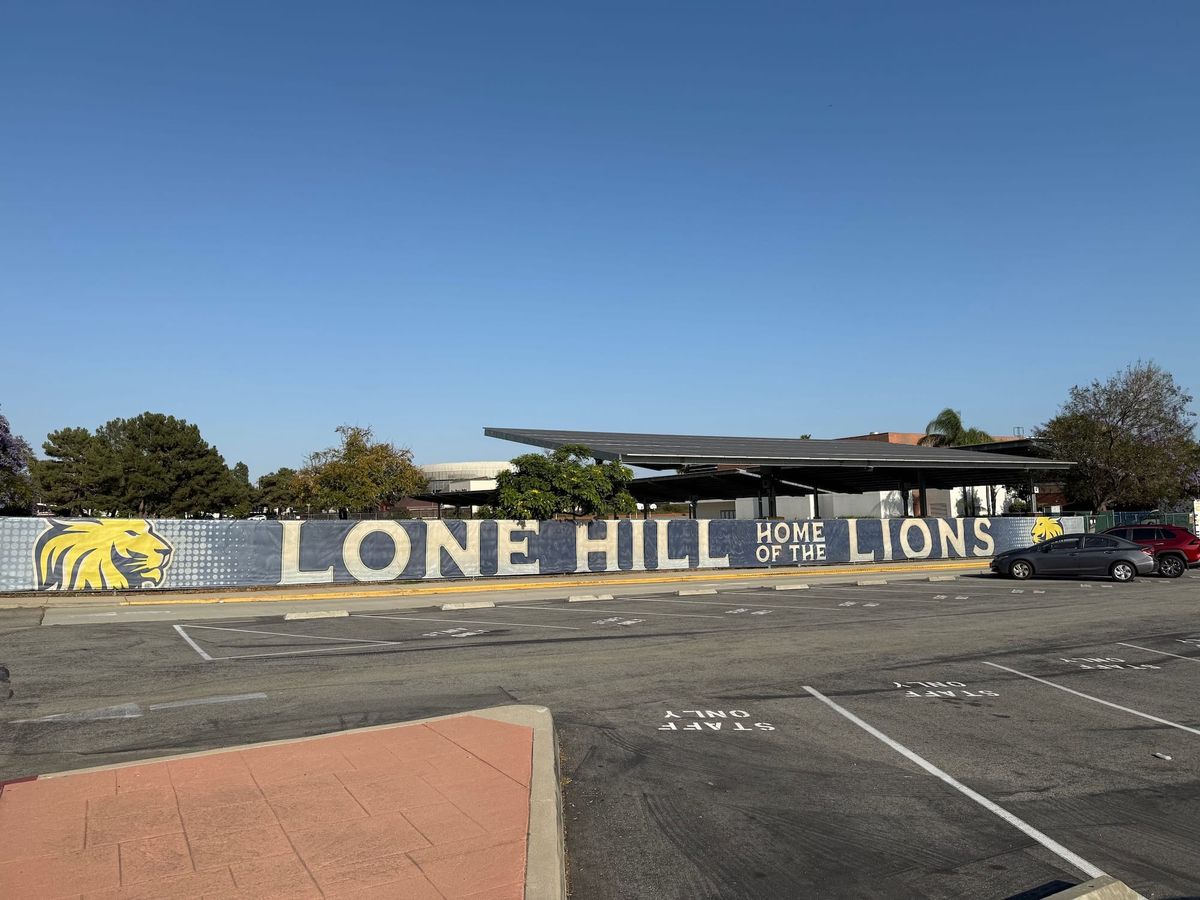
“First, we would go without,” said BUSD Board of Education President Derek Bahmanou in an email to La Verne Daily News, pointing to the aging air conditioning system at Lone Hill Middle School as one example of a deferred maintenance project the district cannot currently afford to fully address because asbestos insulation would also need to be removed.
“We cannot fix this old and ineffective AC system without removing the asbestos insulation,” he said. “Asbestos removal is expensive, and this is beyond what we can afford with our current budget.”
Bahmanou said the district would not have asked voters to approve a bond measure unless the funding was necessary.
School Board member Jim Elliot said delaying major infrastructure upgrades would likely increase long-term costs as facilities continue to deteriorate and maintenance needs place additional pressure on the district’s general fund budget.
“Bonita Unified's infrastructure needs are not going away,” Elliot said. “It’s not just the future cost of money, materials, or labor, it's that today's HVAC systems will continue to deteriorate on a larger scale and encroach into the general fund budget, which will eventually take money out of the classroom.”
Bahmanou said if voters reject the measure, the district could attempt to bring another bond proposal back in the future.
“Secondly, we would try again,” he said. “We cannot control how people vote, but we can control what we present to the voters. Voters might be more inclined to support the bond after they see the negative impact of non-investment.”
In the meantime, he said the district would continue handling only the maintenance projects it can afford while larger deferred maintenance needs remain unresolved.
“If the bond does not pass, we will continue to do the basic maintenance that we can afford,” Bahmanou said. “We would continue to ignore these big deferred maintenance projects until we can find the revenue.”
How do schools, taxes and affordability factor into housing decisions?
School quality is one of several factors homebuyers often consider when choosing where to live, alongside housing costs, safety, commute times, neighborhood amenities and property taxes.
Angelina Sauer, a realtor with Kaleo Real Estate Company, said many buyers researching communities ask about local schools, especially families with children or those planning ahead.
“Parents with young children—even those not yet in school—are often already thinking ahead and looking for homes in well-rated school districts,” Sauer said.
Lori Alvarez, founder and realtor with Real Estate REsolved, said school ratings and district reputation are commonly part of conversations with buyers, though they are only one piece of a broader housing decision.
“Strong schools are one of the biggest drivers of long-term property value and community stability,” Alvarez said. “Buyers consistently look at school quality when choosing where to live, especially families planning for the long term.”
At the same time, housing affordability and taxes can also influence purchasing decisions. Alvarez said communities often face competing pressures between maintaining infrastructure and keeping housing costs manageable for residents and future buyers.
“The challenge for communities today is finding a balance between investing in schools and infrastructure while also protecting long-term affordability for homeowners and future buyers,” Alvarez said. “Both matter because healthy schools and affordable housing are deeply connected to the long-term strength of a community.”
On real estate platforms such as Zillow and Redfin, school ratings are often displayed alongside home listings, and buyers may compare districts as part of their search process.
Current Bonds
I have reached out to BUSD for more information regarding current bonds but did not hear back in time for publication. I will update this section if new information becomes available.
BUSD's Measures C/AB are also GO bonds.
Measure C, passed in 2004 (passage rate 62.1%)
$56.36 million
Expires in 2031
Measure AB, passed in 2008 (passage rate 60.8%)
$83.56 million
Expires in 2038
Note: BUSD plans to refinance a portion of its outstanding bond debt after the recent decline in interest rates, a move district officials say could reduce repayment costs by about $1.3 million.
The bond proceeds for Measure C and Measure AB were spent between 2008 and 2019. However, homeowners will continue paying these taxes until they expire.
What projects were paid for from Measure C and Measure AB funds?
BUSD budgets and expenditures for Measure C and Measure AB bonds are available on the Capital Program Management project website. However, these files are dated January 2019. I was unable to find more recent reports in time for publication, but I will update this section if more information becomes available.
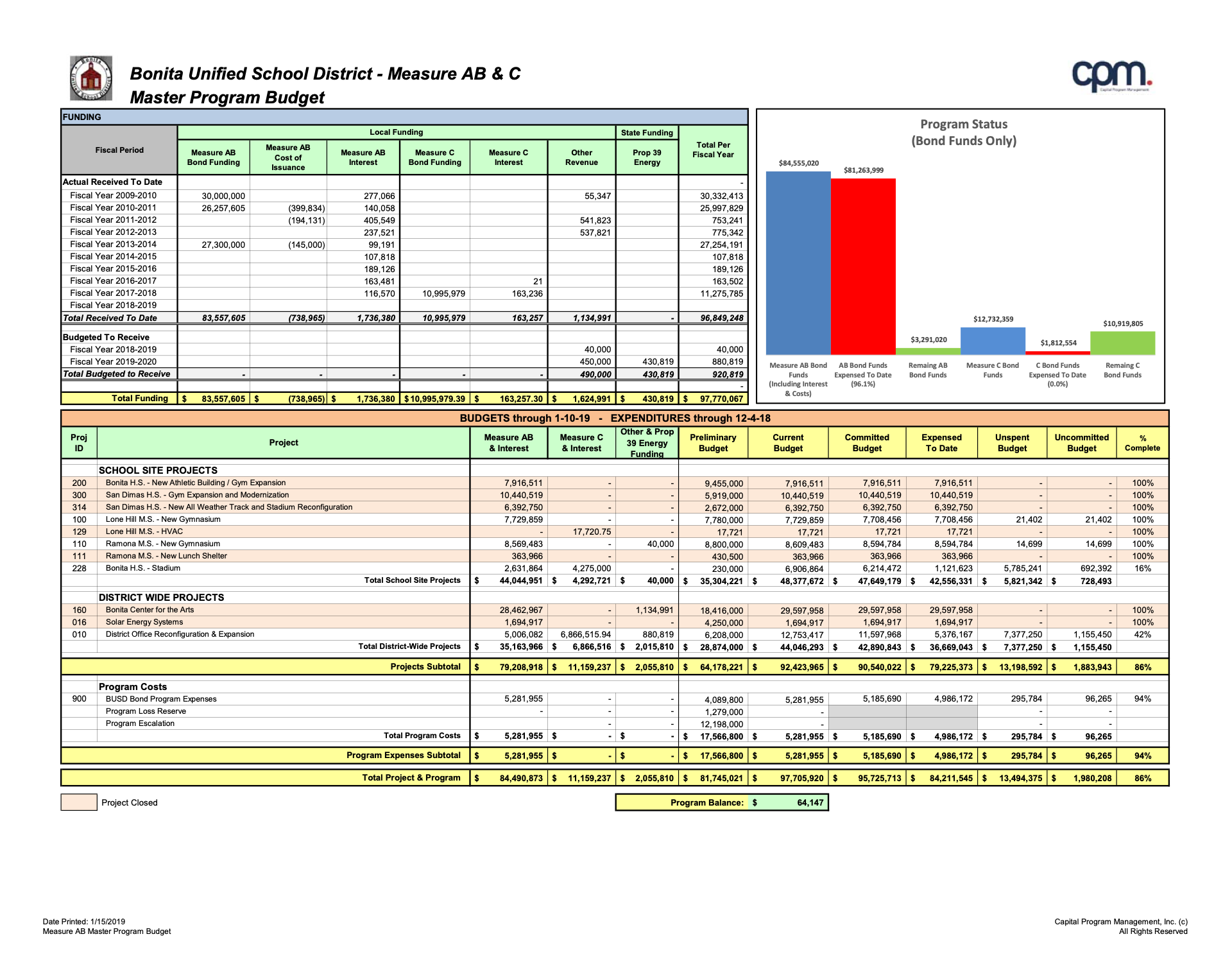
More information on the Measure C and Measure AB funding and expenditures is available in the Bond Oversight Committee's Annual Reports, available on the BUSD website.
How much does BUSD spend on salaries?
Employee compensation makes up the largest share of Bonita Unified’s operating budget. BUSD School Board member Jim Elliot said about 85% of the district’s budget goes toward salaries and benefits for more than 1,000 employees.
According to BUSD’s adopted 2025-26 budget:
- certificated salaries were budgeted at about $69.3 million,
- classified salaries at about $25.7 million,
- employee benefits at nearly $37 million,
- and retirement benefits at about $12.7 million.
Combined salary and benefit costs total more than $144 million.
District officials have said most school district operating budgets are largely dedicated to staffing and instructional services, while facilities projects are typically funded through separate capital or bond funds. Roughly 3% of the budget is set aside for facilities maintenance.
The district’s budget separates spending into restricted and unrestricted funds. Restricted funds must be used for specific programs or legal purposes, while unrestricted funds can be used for general operations and other district expenses.
How to learn more
Voters can review materials posted on the Bonita Unified School District website.
🔗 Facilities Master Plan
🔗 Bond FAQ
🔗 Bond fact sheet
🔗 Ballotpedia
La Verne Daily News has been covering Measure A since district leaders first signaled the district was moving toward a bond measure in January.
 Staci Baird
 Staci Baird
 Staci Baird
 Staci Baird
 Staci Baird
Disclosure: The editor has children who attend schools in the Bonita Unified School District.
Coverage like this takes hours of community reporting, meetings, interviews, and document review. La Verne Daily News is funded primarily by readers—not hedge funds, billionaires or corporate owners.
If this reporting helps you stay informed, consider becoming a paying subscriber.